 Carlos E. Torres
What is AI Observability?
Traditional monitoring tells you if a system is down. AI Observability reveals why your model is misbehaving in the real world. Here is your quick guide to the key pillars, top tools, and trends keeping modern AI reliable.
July 31, 2026 · 3 min read


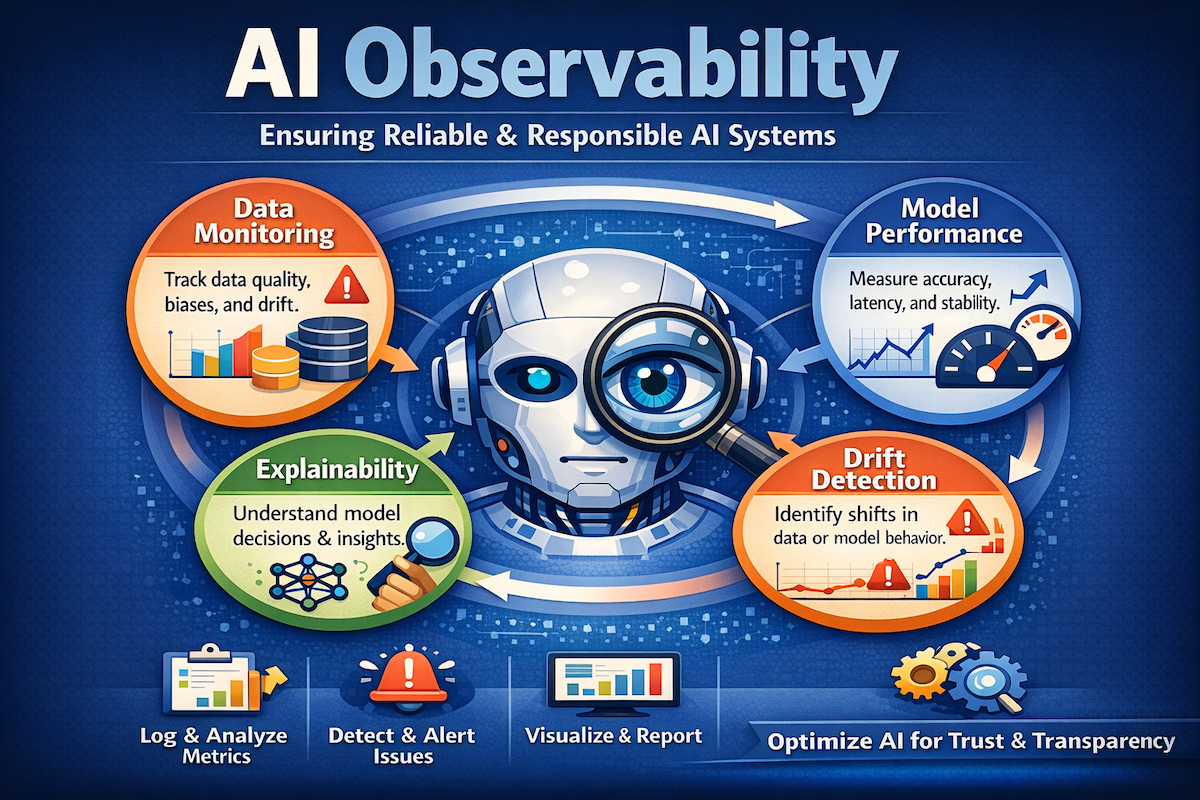
Think of AI Observability as the advanced "health monitor" for artificial intelligence systems.
While traditional monitoring tells you if a system is down, observability helps you understand why a model is behaving a certain way once it’s out in the wild. It’s the practice of tracking, debugging, and improving ML models by analyzing their inputs, outputs, and internal states.
Why It Matters
In a lab, models are predictable. In the real world, data changes, users ask weird questions, and models "drift" away from their original accuracy. Without observability, your AI is a black box that could be hallucinating or providing biased answers without you realizing it.
The Four Pillars of AI Observability
1. Model Performance Monitoring
This tracks the standard metrics to ensure the "engine" is still running correctly.
- Accuracy & Precision:Is the model still getting the right answers?
- Latency: How long does it take for the AI to respond?
- Resource Utilization:Is the model burning through too much GPU or memory?
2. Drift Detection
Data drift occurs when the data the model sees in the real world starts looking different from the data it was trained on.
- Concept Drift:The relationship between the input and the target changes (e.g., consumer behavior shifts after a global event).
- Feature Drift:The distribution of the input data itself changes.
3. Data Quality & Integrity
AI is "garbage in, garbage out." Observability tools look for:
- Missing values or nulls in the input.
- Schema changes (e.g., a field that used to be a number is now a string).
- Outliers that could skew the model's logic.
4. Explainability & Fairness
This is about opening the "black box."
- Feature Attribution:Which specific piece of data caused the model to make a certain decision?
- Bias Detection:Is the model performing worse for specific demographic groups?
AI Observability vs. Traditional Monitoring
How it works in a Workflow
- Instrumentation: You add "sensors" to your AI pipeline to capture inputs and outputs.
- Baseline: You establish what "normal" looks like based on training data.
- Alerting: If the model’s confidence scores drop or drift is detected, the system pings an engineer.
- Root Cause Analysis: The engineer uses the observability data to trace the error back to a specific data source or a need for retraining.
Pro Tip: For Generative AI (LLMs), observability also includes tracking "hallucinations" and "toxicity" to ensure the bot isn't going rogue.
In 2026, the AI observability landscape has split into two distinct categories: Model-Centric (Traditional ML/Predictive)and Agent-Centric (Generative AI/LLMs).
Top AI Observability Tools & Frameworks
I have ranked these based on their production-readiness, feature depth (drift + explainability), and ecosystem integration.
Arize AI
- Enterprise ML
- Root cause analysis, embedding visualization, and "Phoenix" (open-source eval).
- Commercial / OSS
Braintrust
- AI Agents & LLMs
- Highly integrated evaluation-driven observability for complex agentic flows.
- Commercial
Fiddler AI
- Governance/Regulated
- Industry-leading explainability, bias detection, and "model integrity" guardrails.
- Commercial
WhyLabs
- Data Quality
- Robust statistical monitoring and anomaly detection for data pipelines.
- Commercial / OSS
LangSmith
- Prototyping
- The "Gold Standard" for debugging and tracing LangChain applications.
- Commercial
Evidently AI
- Open Source
- The most extensible library for building custom validation and drift reports.
- Open Source
Levo.ai
- Agent Security
- Focuses on "trust leaks" and unsafe tool usage in agentic systems.
- Commercial
Market Dominance: Who is winning?
The market is currently undergoing a "Consolidation Phase." According to 2026 industry data, 84% of organizations are looking to consolidate their AI tools into a single pane of glass.
- Most Used (Modern Stack): Arize AI and WhyLabs dominate the MLOps teams. For GenAI specifically, LangSmith (for developers) and Braintrust (for product teams) have the highest seat counts.
- The "Big Three" Expansion: Traditional observability giants (Datadog, Dynatrace, and New Relic) have aggressively added AI layers. While they are "most used" by sheer volume of existing customers, they are often viewed as less deep than specialized tools like Fiddler.
- Open Source Resilience: Arize Phoenix and Evidently AI are the go-to frameworks for teams that prioritize data privacy and self-hosting.