 Carlos E. Torres
Is Fine-Tuning AI Models Still Needed?
Fine-tuning is no longer the default first move, yet the frontier models we prompt so casually only exist because of it. A practical look at when to prompt, when to retrieve, and when to train.
August 3, 2026 · 6 min read


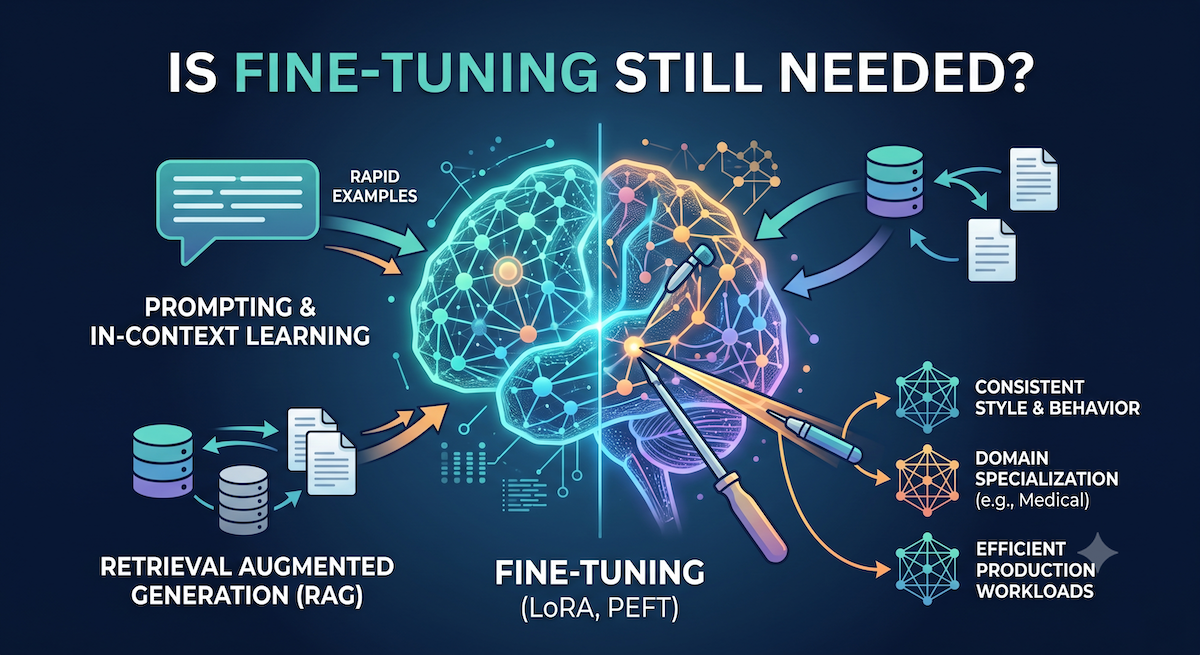
A few years ago, if you wanted a language model to do something specific, fine-tuning was practically the only serious option. Today, with massive context windows, retrieval augmented generation, and frontier models that follow instructions remarkably well out of the box, I keep hearing the same question from engineers and product teams: is fine-tuning still needed? As someone who works with LLMs daily, both in production systems and in my PhD research, my short answer is yes, but its role has changed. Let me explain why.
A quick refresher: what fine-tuning actually is
Fine-tuning is the process of adapting a pre-trained model to a specific task or use case by continuing its training on a smaller, task-specific dataset. It is a form of transfer learning. Instead of training a model from scratch, which requires enormous amounts of compute and data, you start from a base model that already has broad knowledge and hone it for your needs.
IBM's excellent explainer on the topic [1] frames the intuition well: it is easier and cheaper to refine a model that has already acquired broad, relevant learnings than to build a new one for that specific purpose. This matters most for models with billions of parameters, where pre-training from scratch is simply out of reach for most teams.
It is also worth remembering that fine-tuning is not one single technique. The umbrella covers several approaches:
- Full fine-tuning: updating all model weights. Powerful but computationally expensive, and it carries the risk of catastrophic forgetting, where the model loses parts of its original knowledge.
- Parameter-efficient fine-tuning (PEFT) [2]: methods like adapters and prompt tuning that update only a small subset of parameters, or add small new components, while freezing the rest.
- LoRA [3] and its variants: a reparameterization technique that trains low-rank update matrices instead of the full weight matrix. QLoRA pushes this further with quantization, making fine-tuning feasible on consumer hardware.
- Instruction tuning and RLHF: the alignment techniques that turned raw text predictors into useful assistants in the first place. Every chat model you use today exists because of fine-tuning.
That last point deserves emphasis. When people ask if fine-tuning is still needed, they usually mean "do I, as a developer, need to fine-tune?" But at the ecosystem level, fine-tuning never stopped being essential. A pre-trained LLM does not answer prompts, it only appends text to them. Instruction tuning and RLHF are what make these models usable at all.
Why the question comes up now
The reason developers doubt fine-tuning today is that the alternatives got very good, very fast.
Prompt engineering and in-context learning. Modern frontier models are strong few-shot learners. A well-crafted system prompt with a handful of examples often achieves what used to require a fine-tuned model. Context windows measured in hundreds of thousands of tokens mean you can include entire style guides, schemas, and example libraries directly in the prompt.
Retrieval augmented generation (RAG) [4]. If your problem is knowledge, RAG is usually the better tool. Fine-tuning is a poor mechanism for injecting facts. It is slow to update, hard to audit, and the model can still hallucinate. RAG keeps knowledge external, fresh, and traceable to a source, which is exactly what most enterprise use cases need.
Agents and tool use. Many tasks that once looked like "teach the model to do X" are now solved by giving the model tools and letting it orchestrate them. The capability lives in the system design, not in the weights.
So for a large class of problems, the honest answer is that you probably do not need to fine-tune. If prompting solves it, prompt. If it is a knowledge problem, retrieve.
Where fine-tuning still wins
That said, there are situations where fine-tuning remains not just relevant but clearly the right choice. The use cases IBM lists [1] map surprisingly well to what I see in practice.
Consistent style and behavior. When you need a model to reliably follow a tone, a format, or an idiosyncratic behavioral pattern across thousands of interactions, fine-tuning bakes it in. Prompts can drift, and long instruction blocks are fragile. Weights are not.
Specialization of smaller models. This is the big one in 2026. A small open model fine-tuned on your task can match or beat a frontier model on that narrow task, at a fraction of the cost and latency, and it can run on your own infrastructure. For high-volume production workloads, the economics are hard to argue with. Distilling a large model's behavior into a small fine-tuned one is now a standard pattern.
Domain-specific language. Legal, financial, and especially medical settings involve vocabulary and reasoning patterns that may be underrepresented in pre-training. In my work in healthcare AI, I see this constantly. Clinical documentation has its own dialect, and fine-tuning helps a model speak it natively rather than approximately.
Edge cases and reliability. If your system must handle specific rare situations in a specific way, every single time, fine-tuning on labeled examples of those situations is more dependable than hoping the prompt covers it.
Privacy and proprietary data. Fine-tuning lets you incorporate proprietary patterns into a model you fully control, without sending sensitive data to a third-party API on every request.
A simple decision framework
Here is how I think about it when a new problem lands on my desk:
- Start with prompting. It is the cheapest experiment you can run. If a good prompt with examples solves the problem, you are done.
- If the problem is knowledge, use RAG [4]. Facts belong in a retrieval layer, not in weights.
- If the problem is behavior, format, or specialization, consider fine-tuning. Especially if you need consistency at scale, lower latency, lower cost per request, or a small self-hosted model.
- Combine them. The strongest production systems I have seen use a fine-tuned model for behavior and style, RAG for knowledge, and careful prompting on top. These techniques are complementary, not competitors.
Final thoughts
Fine-tuning is no longer the default first move, and that is a healthy sign of a maturing field. But declaring it obsolete misunderstands both the technology and the economics. The frontier models we prompt so casually are themselves products of fine-tuning, and for teams that need specialized, consistent, efficient models they can own and control, techniques like LoRA have made fine-tuning more accessible than ever.
The question is not whether fine-tuning is still needed. It is whether your specific problem is a prompting problem, a retrieval problem, or a weights problem. Learning to tell the difference is one of the most valuable skills an AI engineer can develop right now.
References
- Bergmann, D. (2024). What is fine-tuning? IBM Think. https://www.ibm.com/think/topics/fine-tuning
- IBM Think. What is parameter-efficient fine-tuning (PEFT)? https://www.ibm.com/think/topics/parameter-efficient-fine-tuning
- Hu, E. J., et al. (2021). LoRA: Low-Rank Adaptation of Large Language Models. arXiv. https://arxiv.org/abs/2106.09685
- Lewis, P., et al. (2020). Retrieval-Augmented Generation for Knowledge-Intensive NLP Tasks. arXiv. https://arxiv.org/abs/2005.11401