 Carlos E. Torres
Human-Centered AI: Putting People at the Heart of Intelligent Systems
Human-Centered AI: Why building AI that amplifies people, rather than replaces them, is the research question at the heart of my PhD journey.
July 31, 2026 · 5 min read


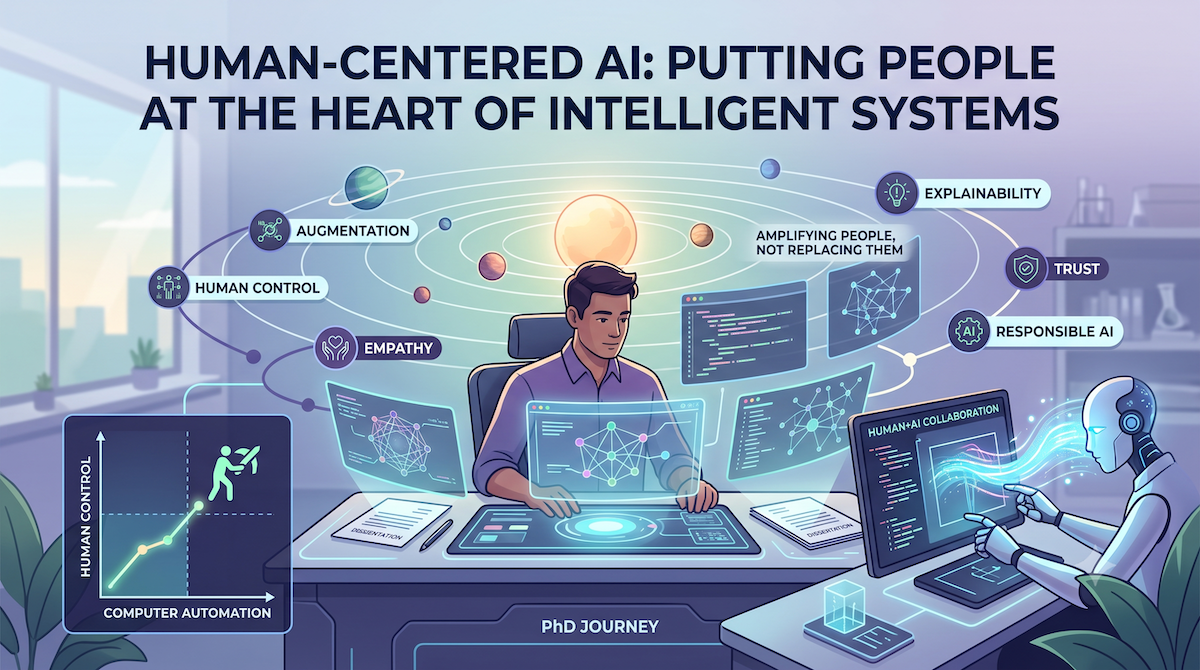
Artificial intelligence has moved from research labs into nearly every corner of our lives. It recommends what we watch, helps design new drugs, writes code alongside us, and increasingly makes decisions that affect real people. As a software engineer and researcher, and especially as I shape my PhD research proposal and dissertation, one question keeps pulling me in: how do we build AI systems that genuinely serve people, rather than simply automating them away?
This question is the core of an emerging discipline called Human-Centered AI (HCAI), and it has become the lens through which I want to frame my doctoral research in AI, machine learning, and natural language processing.
What is Human-Centered AI?
Human-Centered AI is the study and design of AI systems that amplify and augment human abilities instead of displacing them. IBM Research [1], one of the groups actively shaping this field, describes HCAI as a discipline focused on preserving human control while ensuring that AI meets our needs, operates transparently, delivers equitable outcomes, and respects privacy.
The central insight is deceptively simple. No matter how autonomous an AI system appears, people remain critical in its design, operation, and use. The long-term success of AI depends on acknowledging that human element, not engineering around it.
Ben Shneiderman [3], a pioneer of human-computer interaction at the University of Maryland, calls this shift a "second Copernican Revolution." Instead of placing algorithms at the center of systems design and asking humans to orbit around them, HCAI puts people at the center and asks what technology must do to earn their trust.
High automation and high human control
One of the most influential ideas in HCAI comes from Shneiderman's [4] two-dimensional framework. The traditional view treats automation as a slider: more automation means less human control. Shneiderman [5] argues this is a false trade-off. Human control and computer automation are two separate axes, and the best systems score high on both.
Think of a modern digital camera. Internally, it performs an enormous amount of automation, handling light sensing, stabilization, and image processing. Yet the photographer retains granular, immediate control over the creative result. That is the design target for AI: systems that are reliable, safe, and trustworthy precisely because a person can understand, steer, and override them.
This reframing also changes our language. Rather than building "autonomous teammates" that emulate humans, HCAI encourages us to build powerful, tool-like systems, what Shneiderman calls supertools, that empower people to do their work more fluently.
The pillars of the field
IBM Research [2] organizes its HCAI work around three themes that I find especially useful as a map of the research landscape:
Human-AI collaboration and co-creation. The premise is that "human + AI" outperforms either one alone. A great example comes from data science itself. When IBM researchers studied how data scientists felt about automating their own work, they found that the future of the field would be a collaboration where both automation and human expertise are indispensable. Those insights shaped tools like AutoAI, which help practitioners build better models faster while keeping them in the loop.
Responsible and human-compatible AI. For AI to produce beneficial outcomes for users and society, it must be fair, secure, ethically applied, and understandable. Explainability turns out to be more than an academic concern. In IBM's SCORE sales recommendation system, explainable recommendations that showed clear evidence for each suggestion were critical to earning users' trust, and that trust translated into hundreds of millions of dollars in incremental revenue.
Natural language interaction. As conversational interfaces and large language models become the dominant way people interact with AI, we need to understand which tasks suit this medium, how effective these interactions are, and how cultural and linguistic context shapes them. IBM's studies on formal versus informal language in Brazilian Portuguese chatbots are a fascinating reminder that human-centered design is also culturally situated.
Why this matters for my research
My professional life has always sat at the intersection of engineering and human experience. I have built products where design, UX, and animation were not decoration but the substance of how people understood the software. Now, working daily with large language models and generative AI, I see the same pattern at a much larger scale: the hardest problems are rarely about model capability alone. They are about interaction, trust, explainability, and control.
That is why HCAI feels like the right foundation for my PhD research proposal and, eventually, my dissertation. The frontier questions excite me. How do humans and generative AI systems negotiate shared goals when the AI optimizes for accuracy but people care about fairness, personalization, and context? How do we design co-creative partnerships where the person handles goal setting, curation, and high-level creativity, while the AI contributes inspiration, detail work, and the ability to design at scale? How do we evaluate these hybrid systems in ways that capture human outcomes, not just benchmark scores?
The field of AI is at an inflection point. We can keep chasing raw capability, or we can do the harder, more interesting work of making that capability reliable, safe, and trustworthy for the people who use it. I believe the second path is where the most meaningful research of the next decade will happen, and it is the path I intend to follow.
Further reading
- Xu, W. (2019). Toward human-centered AI: A perspective from human-computer interaction. Interactions, 26(4), 42-46. https://doi.org/10.1145/3328485
- Li, F.-F. (2018). How to Make A.I. That's Good for People. The New York Times. https://www.nytimes.com/2018/03/07/opinion/artificial-intelligence-human.html
References
- IBM Research. Human-Centered AI. https://research.ibm.com/topics/human-centered-ai
- Geyer, W., Weisz, J., Pinhanez, C. S., & Daly, E. (2022). What is human-centered AI? IBM Research Blog. https://research.ibm.com/blog/what-is-human-centered-ai
- Shneiderman, B. (2020). Human-Centered Artificial Intelligence: Reliable, Safe & Trustworthy. International Journal of Human-Computer Interaction, 36(6), 495-504. https://doi.org/10.1080/10447318.2020.1741118
- Shneiderman, B. (2020). Human-Centered Artificial Intelligence: Three Fresh Ideas. AIS Transactions on Human-Computer Interaction, 12(3), 109-124. https://doi.org/10.17705/1thci.00131
- Shneiderman, B. (2022). Human-Centered AI. Oxford University Press.